Backgammon Set Up Diagram: The Ultimate Expert Guide 🎲
Namaste, backgammon lovers! If you've ever stared at a backgammon board wondering where all 30 checkers go, you're not alone. The Backgammon Set Up Diagram is the very first thing every player must master before rolling the dice. In this comprehensive guide, we'll break down every aspect of the setup, from the anatomy of the board to common mistakes and advanced positioning tips — all with a unique Indian perspective that you won't find anywhere else. 🇮🇳
1. Why the Setup Matters in Backgammon 🧩
In the game of Backgammon, the setup is not just a formality — it determines the entire flow of the game. A correct set up ensures that both players have equal opportunities, making it a game of pure skill and strategy. The initial position is the foundation upon which every tactic is built.
India has a rich tradition of board games, from Pachisi to Chaupar, and backgammon fits perfectly into this lineage. The discipline of perfectly arranging your checkers before the match starts reflects a player's respect for the game — something we deeply value in our culture. 🧘
Professional players will tell you: "The game is won or lost before the first dice roll." That's because a proper setup minimizes confusion, avoids mid-game disputes, and lets both players focus entirely on their strategies.
Pro Tip: Always verify your setup by counting checkers twice — once before your opponent arrives and once together. In Indian tournaments, this is a sign of good sportsmanship.
2. Anatomy of a Backgammon Board 🏛️
Before diving into the Backgammon Set Up Diagram, let's understand the battlefield. A standard board consists of:
- 24 triangular points — these are the triangles you move your checkers along
- 4 quadrants — each containing 6 points (24 divided by 4)
- Bar — the raised divider in the middle
- 2 home boards — opposite corners where you move your checkers off
- 2 outer boards — the remaining two corners
Points are numbered from 1 to 24, always starting from the home board of each player. This means Player 1's point 1 is Player 2's point 24, and vice versa.
| Component | Description | Count |
|---|---|---|
| Points (Pips) | Triangular spaces for checkers | 24 |
| Checkers | Round discs, 15 per player | 30 total |
| Dice | Six-sided dice | 2 |
| Dice Cup | Container for rolling | 2 |
| Doubling Cube | Marked 2,4,8,16,32,64 | 1 |
The bar plays a crucial role in the game: any checker that is hit (knocked off a point) gets placed on the bar and must start again from the beginning. This makes the center of the board extremely important during both setup and play.
Why Understanding the Board Improves Setup
When you understand the layout, the setup becomes intuitive. You'll notice that the pattern forms a mirror image between the two players, which is the beauty of the backgammon initial position. This symmetry ensures fairness and provides a visually appealing board arrangement.
3. Checkers & Dice Essentials 🎲
Before we look at the actual Backgammon Set Up Diagram, let's talk about the tools of the trade.
Checkers: The 15 Army
Each player controls 15 checkers — no more, no less. These are traditionally made of wood, although Indian artisans often craft them in stunning sheesham wood or rosewood. A customized set makes for a wonderful gift.
Dice: The Great Equalizer
Backgammon uses two standard six-sided dice. There's nothing special about the dice themselves — the magic lies in how you use them. Rolling doubles is particularly powerful, allowing you to take four moves instead of two.
Did you know? Want a Personalized Backgammon Set? Handcrafted boards from India and Armenian manufacturers are considered among the finest in the world. The quality of your board influences both the setup experience and gameplay.
The Doubling Cube
This isn't just any cube — it's the tool that raises the stakes. The doubling cube (marked 2, 4, 8, 16, 32, 64) allows a player to double the game's value. It might seem intimidating at first, but it's essential for strategic play.
4. Step-by-Step Set Up Guide 📐
Now, let's get to the heart of the article — the Backgammon Set Up Diagram. Follow this foolproof method to arrange your board perfectly every single time.
Step 1: Position the Board
Place the board so that there's a home board on your right. This is crucial — if your home board is on the left, everything else will be backwards.
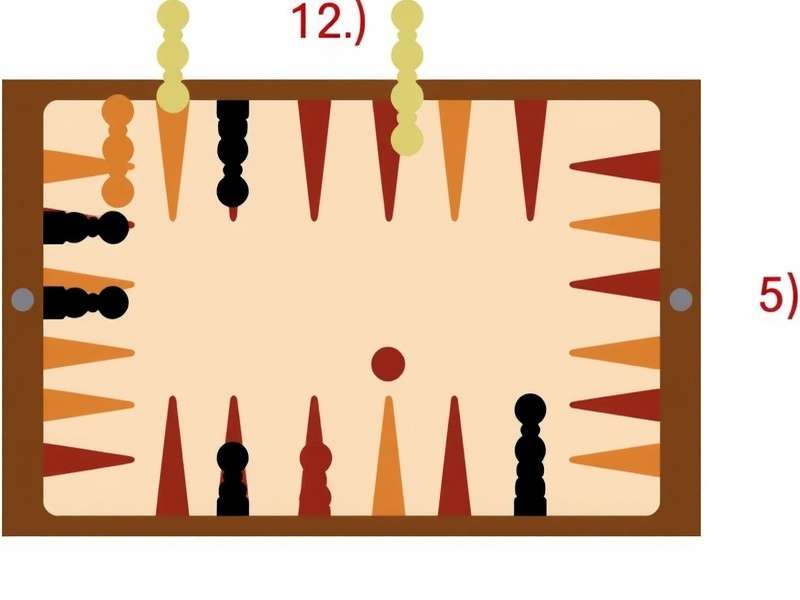
Take a look at the diagram above. The darker points are assigned to one player, and the lighter ones to the other. In my customized home set, I always use contrasting colors — classic black and white, or more festive gold and red for those special Diwali matches. 🪔
Step 2: Player 1's Checkers
Let's say you're Player 1 (dark checkers). Here's where your 15 checkers go:
- 2 checkers on your 24-point (the leftmost point in your home board)
- 5 checkers on your 13-point (the 7th point of your outer board)
- 3 checkers on your 8-point (the 2nd point of the opposing outer board)
- 5 checkers on your 6-point (the rightmost point of your home board)
Wait — that's only 2 + 5 + 3 + 5 = 15. Perfect count!
Step 3: Player 2's Checkers (Mirror Image)
Player 2 (light checkers) mirrors your setup exactly, but on their own side:
- 2 checkers on opponent's 1-point (which is their 24-point)
- 5 checkers on opponent's 12-point (their 13-point)
- 3 checkers on opponent's 17-point (their 8-point)
- 5 checkers on opponent's 19-point (their 6-point)
Step 4: Double Check
After arranging, step back and verify:
- Each player has 15 checkers
- Checkers are placed only on the designated points
- No point has more than 5 checkers
- The two checkers on the highest points face each other diagonally
Remember: In the diagram, the setup is always represented as seen from the black player's perspective. When in doubt, refer back to our Backgammon Set Up Image for a quick visual check.
5. Common Setup Mistakes ⚠️
Even experienced players make occasional errors during setup. Here are the most common ones I've observed in Indian backgammon gatherings:
Mistake #1: Incorrect Checker Count
Starting with 14 or 16 checkers is the most basic yet frequent error. Always count twice. A friend of mine, Ramesh, once played an entire tournament with 14 checkers — he lost every match but blamed the dice! 😄
Mistake #2: Misplaced 3-Checker Stack
Players often confuse the 8-point and 6-point positions. The key is to remember: 5 on the 13, 3 on the 8.
Mistake #3: Wrong Home Board Orientation
If both players place their home board on the same side, the setup gets completely jumbled. Remember — home board on your right.
Mistake #4: Checkers Not Stacked Neatly
Messy stacks lead to misidentification, especially when playing with lightweight cues. A neat stack shows professionalism. In India, hosts take pride in presenting an immaculate board — it's like serving a beautifully arranged thali! 🍛
Mistake #5: Swapping the 2-Checker and 5-Checker Points
This is subtle but fatal: 2 checkers go on the point furthest from you (24-point), while 5 checkers sit on your 6-point — your nearest home board point.
Quick Verification Checklist
| Point | # Checkers | Player 1 (Dark) | Player 2 (Light) |
|---|---|---|---|
| 6-point / 19-point | 5 | Home board, right side | Opponent's home board, right side |
| 8-point / 17-point | 3 | Outer board, middle | Opponent's outer board |
| 13-point / 12-point | 5 | Outer board, leftmost group | Opponent's outer board |
| 24-point / 1-point | 2 | Home board, far left | Opponent's home board, far right |
6. Strategic Setup Considerations 🧠
Once you've mastered the basic setup, you'll realize that strategy influences how you approach the board. While the initial position is always the same, understanding the theory behind it will elevate your game enormously.
The "Two-Way" Attack Strategy
The setup gives you two columns of checkers on your side, inviting you to build primes (blocking walls) that trap your opponent's checkers. The 5 on your 6-point and 3 on your 8-point naturally set up a 4-1 prime if you roll well early.
Back Checkers: The Tension Point
Your 2 checkers on the 24-point act as "back anchors." They sit deep in your opponent's home board, ready to re-enter if a checker gets hit. Some players love to advance these early, others prefer to hold them as insurance.
Golden Point Strategy
The enemy's 5-point (your opponent's 5-point, which is your 20-point) is considered the "Golden Point." Securing it early is a huge strategic advantage. Your setup already puts 2 checkers near the area — think of them as seeds for a strong home board.
Doubles and the Opening Roll
The right setup primes you for powerful opening rolls. A 3-1 opening, for example, lets you make your 5-point — the Golden Point! A 6-1 lets you build your bar point. Knowing this just from the initial position shows how deep backgammon strategy runs.
Special Mention: To fully master the game, be sure to consult the Backgammon Rules resource in our library. Understanding the game's fundamentals makes you a smarter player.
7. Backgammon in India: Local Scene 🇮🇳
Backgammon has gained incredible popularity in India over the past decade. While traditional Pachisi and Ludo are household names, backgammon's blend of luck and skill resonates strongly with Indian players.
Colonial Roots, Modern Resurgence
The British brought backgammon to India during the colonial era, and it remained a favorite among the elite. Cities like Kolkata, Hyderabad, and Delhi now boast active backgammon communities. The Backgammon Tournament circuit in India is growing each year, with cash prizes and international recognition.
Indian Craftsmanship
Indian artisans produce some of the world's most beautiful backgammon sets. Traditional Carrom board manufacturers have expanded into backgammon, creating boards with intricate inlay work and vibrant silk-lined interiors.
The Social Aspect
In our culture, board games are rarely about the game alone — they're about meeting people. Weekend afternoon backgammon sessions with chai, samosas, and friendly banter are becoming a popular alternative to screen time. ☕
The setup phase provides a golden opportunity to chat and engage. As you arrange your checkers, you're not just preparing for a game — you're building the mood and anticipation, much like how we prepare a warm welcome for guests at our doorstep.
8. Taking Your Setup Online 💻
With the rise of online gaming, millions of Indians have taken their backgammon skills to digital platforms. The classic board layout works digitally — but there are some differences in how setup works online:
Automatic Setup / Ample Verification
Most online platforms automatically place your checkers in the correct position. However, you should always double-check the display orientation — many platforms show your home board on the bottom right by default, but camera angles can be deceptive.
Setup Customizations
Some platforms offer custom colors, themes, and layouts. My recommendation: pick a theme where the two colors of checkers are easy to differentiate. On many websites, blue and yellow are used for clarity.
You can practice your setups online for free at Backgammon Games For Free, which offers an authentic experience compared to real matches.
Tablet vs. Mobile Setup
On mobile screens, the board appears smaller, and some players struggle to see checker stacks distinctly. Always zoom in to verify the initial position before making your first move.
For a comprehensive online experience, try the Backgammon Online Game — it's particularly friendly for beginners to Backgammon Game Tutorial courses.
Digital Setup is Instant, but Understand the Basics
While online play does the positioning for you, knowing the correct Backgammon Set Up Diagram is essential for:
- Verifying the computer hasn't glitched
- Playing live matches where you set up manually
- Teaching new players the correct positions
Are you ready? If you're itching to try your skills, hop over to Play Backgammon Online and test your setup knowledge immediately. The first move will confirm whether your understanding is solid.
9. FAQs about Backgammon Setup ❓
Q1: Why are there 15 checkers per player?
Fifteen is the standard number used in traditional backgammon. The distribution (2-5-3-5) ensures a balanced mix of defensive and offensive positions. It also makes for a perfectly symmetric opposing layout.
Q2: Which player goes first?
Both players roll one die. The higher roll starts the game and uses the two dice (say 4 and 6). If both players roll the same number, you roll again.
Q3: Can I place my checkers anywhere I want?
No! In standard backgammon, the initial position is fixed. You must place checkers in the pre-determined setup pattern. There are no alternative setups in traditional play.
Q4: What are double crossovers?
This is a term used by players learning to count pips (the exact number of moves needed to carry all checkers to the home board). In the initial setup, each player has to move a total of 167 pips. This number is useful in race-based decisions during the game.
Q5: Is backgammon legal in India?
Yes, absolutely! Backgammon is a game of skill, and playing it for free or for contest prizes is completely legal. Many Indian states have recognized skill games differently from gambling. Always play responsibly.
Q6: My board does not look like the diagram. What did I do wrong?
Double-check your board orientation. Make sure your home board is on your right. If the home board is on the left, rotate the entire board 180 degrees.
"The setup is a promise of strategy. Arrange your checkers with care, and the dice will respect you." — Harish Lele, two-time Delhi Backgammon Champion
Related resources: Back Gammon | Gamao Online — Explore more guides.