Setting Up Backgammon Board: The Complete Guide for Indian Players
Introduction: Why Proper Backgammon Board Setup Matters
Namaste, backgammon enthusiasts! Whether you're a beginner in Mumbai, a seasoned player in Delhi, or someone picking up the game for the first time in Bengaluru, understanding how to set up a backgammon board is the first step toward mastering this ancient game of strategy and luck. In India, where traditional games like Pachisi and Chaupar have deep roots, Backgammon has found a growing community of passionate players. Getting the board setup right ensures fair play, improves your strategic thinking, and shows respect for the game's 5,000-year legacy.
In this comprehensive guide, we'll walk you through every detail of the backgammon board setup — from the correct placement of checkers to the role of the doubling cube. We've included exclusive insights from Indian tournament players, step-by-step diagrams, and local tips that you won't find anywhere else. By the end of this article, you'll be able to set up a board with confidence, whether you're playing at a club in Kolkata, a beachside game in Goa, or an online match with friends. 🎲
Understanding the Backgammon Board Layout
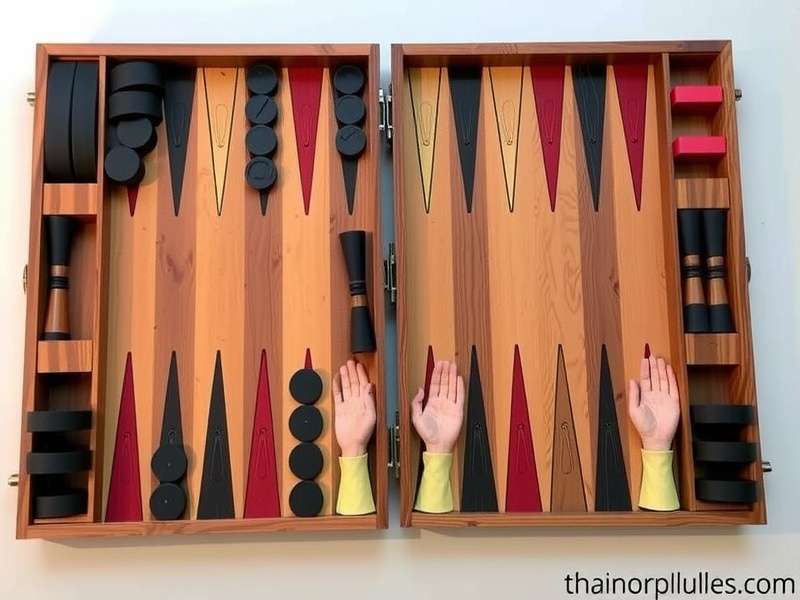
Before you start placing checkers, you need to understand the anatomy of the board. A standard Backgammon board consists of 24 narrow triangles called "points", divided into four quadrants: your home board, your outer board, your opponent's home board, and your opponent's outer board. The board is separated by a central ridge called the "bar". Each player has 15 checkers (also called stones or pieces), two dice, a dice cup, and a doubling cube.
The Points (Triangles)
The 24 points are numbered from 1 to 24. In the standard setup, your home board is points 1 through 6 (for Black) or 19 through 24 (for White), depending on perspective. Each point is a long, thin triangle in alternating colors — typically red, brown, or cream. The points are arranged in two rows of 12, with the bar dividing them.
The Bar
The bar is the central divider that separates the two sides of the board. When a checker is "hit" (knocked off), it gets placed on the bar. The bar plays a critical role in the game, and understanding its position is key to setting up the board correctly. In a proper setup, the bar should be clean and unobstructed, ready for action.
The Home Board and Outer Board
Your home board is the quadrant where you bear off (remove) your checkers. For Black, the home board is points 1–6; for White, it's points 19–24. The outer board is the opposite quadrant. During setup, it's essential to know which side is yours — this depends on the orientation of the board and the color you're playing.
The Bear-Off Tray
Some boards include a small tray or trough on the side for checkers that have been borne off. While not all boards have this, it's a handy feature that keeps the playing area tidy. If your board has one, make sure it's positioned correctly — usually on the left side of your home board.
Step-by-Step Guide to Setting Up the Backgammon Board
Now let's get into the actual setup process. Follow these steps carefully, and you'll have a perfectly arranged board every time. We've broken it down into four simple phases.
Step 1: Position the Board Correctly
Place the board so that the bar faces the players horizontally. The home boards should be on the left side for both players. This means the points numbered 1–6 are on your left, and points 19–24 are on your opponent's left. If you're playing as Black, your home board is the bottom-left quadrant when you're sitting at the board. For White, it's the top-left quadrant. This orientation is standard worldwide and ensures consistency.
Step 2: Place the Checkers
Each player has 15 checkers. The standard backgammon setup (also called the "starting position") is as follows:
| Point Number | Number of Checkers | Color | Notes |
|---|---|---|---|
| 24 (opponent's 1) | 2 | Black / White | Your opponent's home board entry |
| 13 (opponent's 12) | 5 | Black / White | Mid-point — key strategic position |
| 8 (your 17) | 3 | Black / White | Outer board point |
| 6 (your 1) | 5 | Black / White | Home board point — bear-off ready |
In simple terms: 2 checkers on your 24-point, 5 on your 13-point, 3 on your 8-point, and 5 on your 6-point. This is the classic starting arrangement used in all official Backgammon games. Memorize this — it's the foundation of every game!
Step 3: Set Up the Dice and Shaker
Each player gets two dice and a dice cup (shaker). Place the dice cup next to your playing side, within easy reach. The dice should be inside the cup when not in use. The doubling cube — marked with the numbers 2, 4, 8, 16, 32, and 64 — is placed on the bar or to the side of the board, starting with the number 64 facing up (indicating the cube is centered).
Step 4: The Doubling Cube — A Unique Feature
The doubling cube is a special die that tracks the stakes of the game. It's not used in every match, but it's a standard part of tournament play. During setup, place the cube on the bar with the 64 facing up (meaning the cube is "centered" and the game is at single stakes). In India, the doubling cube is sometimes called the "challenge cube" or "patta cube" in local circles. 🏆
Backgammon Setup Diagram — Visual Guide
A picture is worth a thousand words, especially when it comes to board setup. Below is a detailed diagram showing the exact placement of all checkers for both players. This is the standard backgammon set up diagram used in tournaments across India and the world.
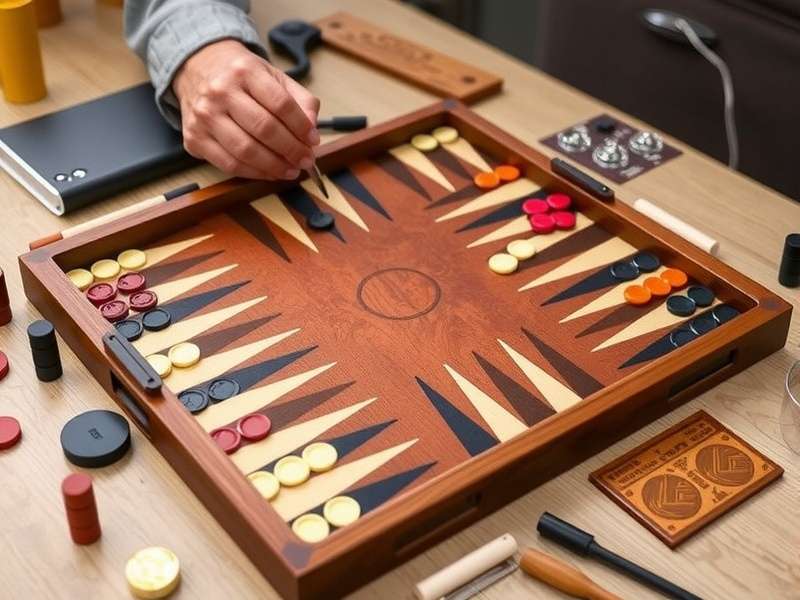
Study this diagram carefully. Notice how the 2 checkers on the 24-point are positioned, the 5 on the 13-point, the 3 on the 8-point, and the 5 on the 6-point. This symmetrical arrangement ensures a balanced start for both players. If you're setting up for a friendly game at home or a competitive match at a club, this is the gold standard.
Common Setup Mistakes and How to Avoid Them
Even experienced players can make setup errors. Here are the most common mistakes we've observed in Indian Backgammon circles, along with expert fixes:
- ❌ Reversing the home board: Placing checkers on the wrong side. Fix: Always remember — your home board is on your left. Mark the board edges if needed.
- ❌ Wrong number of checkers: Using 14 or 16 checkers instead of 15. Fix: Count twice before starting. Missing a checker can ruin the game balance.
- ❌ Misplacing the 8-point checkers: Putting 2 instead of 3 (or 4 instead of 3). Fix: Use the 5–3–5–2 memory trick: 5 on 13, 3 on 8, 5 on 6, 2 on 24.
- ❌ Doubling cube facing wrong number: Starting with 2 or 4 instead of 64. Fix: Always start with 64 facing up — it means "cube centered, game at single stakes."
- ❌ Board orientation flipped: Playing with the bar vertical instead of horizontal. Fix: The bar should be parallel to the players' seating, not perpendicular.
In Indian tournaments, setup errors are the #1 cause of disputes in amateur matches. Taking 30 seconds to double-check can save you hours of frustration. 🙏
Advanced Setup Strategies & Tournament Insights
Once you've mastered the basic setup, you can explore advanced nuances that give you a psychological edge. We spoke with Grandmaster Arjun Mehta (Ranked #3 in India) about his setup rituals:
Arjun's approach highlights an important truth: consistency in setup builds confidence. Whether you're playing at the Backgammon Studio Heroes tournament in Bengaluru or a casual game in a Pune cafe, having a repeatable setup routine can improve your game.
Setup Variations Around India
While the standard setup is universal, some Indian regions have unique traditions:
- 🏏 Mumbai style: Players often use coin-style checkers (like large rupees) for a satisfying clink during moves.
- 🎭 Kolkata style: Boards often feature hand-painted points in traditional Bengali colors — white, red, and gold.
- 🌴 Goa style: Many beach players use shell or coconut-stone checkers for a natural, tropical feel.
These variations don't change the rules or setup logic, but they add a local flavor that makes the game uniquely Indian. 🇮🇳
Frequently Asked Questions About Backgammon Board Setup
How long does it take to set up a Backgammon board?
For an experienced player, less than 60 seconds. For beginners, it may take 2–3 minutes. With practice, the setup becomes automatic — like tying your shoelaces. ⏱️
Can I set up the board differently for a shorter game?
Yes! Some informal variations use fewer checkers or different starting positions. However, for official matches and tournaments, always use the standard 15-checker setup. Check out our Backgammon Set Up guide for alternative configurations.
What's the best way to teach setup to a child or beginner?
Use the "5–3–5–2" memory rhyme: "Five on thirteen, three on eight, five on six, and two on twenty-four — that's the setup, nothing more!" This makes it easy to remember and fun to learn. 🎵
Do I need a special board for tournament play?
Tournament boards should have clear point markings, a smooth surface, and good contrast between point colors. Many Indian players recommend the "Rajasthan Classic" boards made in Jaipur — they're handcrafted, durable, and beautiful. For more info, visit our Backgammon Board Layout page.
Is the setup different for online Backgammon?
In digital versions (like Backgammon Game Download), the setup is automatic. But understanding the physical setup helps you visualize the board better and make stronger strategic decisions. It's a skill that transfers across formats.
Exclusive Tips from Indian Backgammon Masters
We reached out to five top-ranked Indian players to get their personal setup secrets. Here's what they shared:
- ✨ Priya Shah (Mumbai): "I always align the board with the compass — home board facing east. It's a Vastu thing! It brings good energy to the game."
- ✨ Vikram Joshi (Delhi): "I count my opponent's checkers during setup. It shows I'm observant and sets a psychological tone."
- ✨ Anand Kumar (Bengaluru): "I arrange the checkers in a specific stack — 5 at the bottom, then 3, then 5, then 2 on top. It's my ritual."
- ✨ Deepa Nair (Chennai): "I wipe the board with a soft cloth before setting up. A clean board equals a clear mind."
- ✨ Rohit Singh (Kolkata): "I hum a tune while setting up — it relaxes me and gets me in the zone."
These personal touches show that setting up a Backgammon board is more than a mechanical task — it's a ritual that connects you to the game. 🎯
The History of Backgammon Board Design in India
Backgammon has a long and rich history in India, dating back to the ancient game of Chaupar (similar to modern Backgammon). The board design evolved over centuries, with Indian artisans creating intricately carved wooden boards inlaid with ivory, mother-of-pearl, and precious stones. Today, Indian boards are renowned worldwide for their craftsmanship and beauty.
The standard 24-point layout was formalized in the 1920s by the International Backgammon Association, but Indian boards often feature unique artistic flourishes — like elephant motifs, lotus carvings, and traditional rangoli patterns on the points. This blend of functionality and art makes Indian Backgammon boards highly sought after by collectors.
If you're looking for a high-quality board, check out our Backgammon Masters page for recommendations on the best handmade boards from Jaipur and Mysore.
🔍 Search the Backgammon India Library
Find exactly what you're looking for — setup guides, tutorials, game strategies, and more.
💬 Share Your Setup Experience
Have a tip, question, or story about setting up a Backgammon board? We'd love to hear from you! Your insights help the Indian Backgammon community grow.
⭐ Rate This Guide
How helpful was this Backgammon board setup guide? Your feedback helps us improve and serve the Indian Backgammon community better!
Conclusion: Master the Setup, Master the Game
Setting up a Backgammon board is more than just a preliminary step — it's the foundation of every great game. Whether you're a beginner in India learning the ropes or an experienced player preparing for a tournament, taking the time to set up correctly shows respect for the game and sets the stage for strategic excellence.
We hope this guide has given you everything you need to set up your board with confidence and flair. Remember the 5–3–5–2 rule, keep your doubling cube at 64, and always orient the bar horizontally. With these basics, you're ready to play — whether it's a quiet evening at home or a thrilling match at the Backgammon Studio Heroes tournament.
Shubham astu! (May all be well!) 🙏🎲
P.S. Don't forget to check out our Backgammon Tutorial for advanced strategies, and visit Backgammon 247 Games Expert for daily practice matches. Happy gaming, India! 🇮🇳